Pastors are people.
That sounds like an obvious thing to say, but it’s still important to understand.
Unfortunately, Christians sometimes look past the personhood of those who lead in the church. We view spiritual leaders as somehow different, set apart, or above it all. But while Scripture tells us that God holds those who presume to teach to a higher standard (James 3:1), it does not follow that church leaders are somehow immune to the stresses and struggles that plague “regular” Christians.
The Apostle Paul makes an impassioned plea in the opening verses of 1 Corinthians 9 for the church to care for those who lead and preach. While these verses are generally accepted as a call to financially support preachers, they may not just be about provision; perhaps this is also a plea for Christians to see church leaders as human.
In February of 2017, Barna Research Group released a study called “The State of Pastors.” This report provided an in-depth look at the state of the church in the United States and, specifically, how pastors of US churches were faring in self-leadership, church leadership, and cultural leadership. Barna Research Group then released an updated report, “The State of Pastors, Volume 2,” in 2024.
What they found in their second report is likely validating to your experience: Pastors of US churches have gone through an extremely difficult few years. Factors include a bitter political climate, the COVID-19 pandemic, and decreasing resources. As a result, a crisis of pastors’ physical, spiritual, and mental health came to bear in the form of widespread burnout; from January 2021 to March of 2022, the number of pastors who said they were considering leaving their jobs increased from 29 percent to 42 percent. The report authors concluded,
“It seems that pastors’ confidence in their ministry role is closely linked with their personal health.”
he 2024 report, however, is seeded with hope. The authors acknowledge,
“for a while, the day-to-day reality of U.S. pastors seemed quite grim. Recently, however, some signs of relief have begun to appear on the horizon.”
While the numbers are still lower than in the 2017 report, compared to the data from a few years ago, pastors’ reported physical, spiritual, and mental health has started to tick back up. In addition, the authors noted a similar increase in the number of pastors who reported feeling confident in their calling.
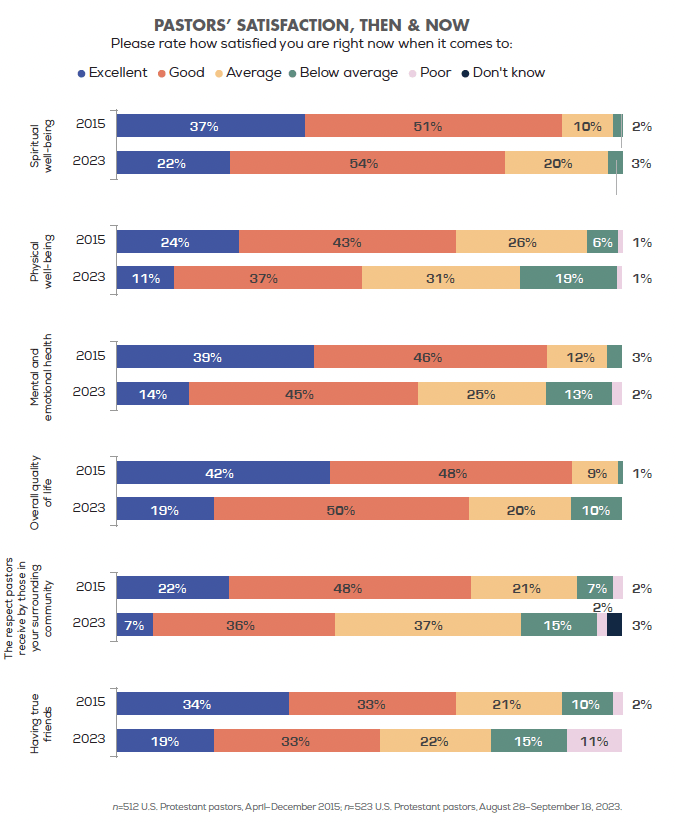
Image from The State of Pastors, Volume 2
Behind each statistic is a story, a real person ministering in the United States today. This research is important because it reinforces both the humanness of our church leaders and how critical personal health is to church leadership.
As you ponder this research, how can you continue to foster an environment for healthy leadership in your church?
Let’s journey together.
You don’t need to do ministry alone. You can find opportunities to connect, plus more content and conversations about church administration, at XP Summit: xpsummit.org.